10 Proven Marketing Strategies for Attracting New Patients to Your Practice

Attracting new patients isn’t just about “getting your name out there.” It’s about making it easy for the right patients to find you, trust you, and book—then ensuring their first experience is so smooth they become long-term advocates. The good news: patient acquisition is highly measurable, and leveraging patient reviews alongside small operational improvements (like faster call handling and simpler intake) often outperform big ad budgets.
Below are 10 proven healthcare marketing and new patient strategies you can implement this quarter—each designed for practice owners and office managers who want predictable growth, including Effective local SEO techniques.
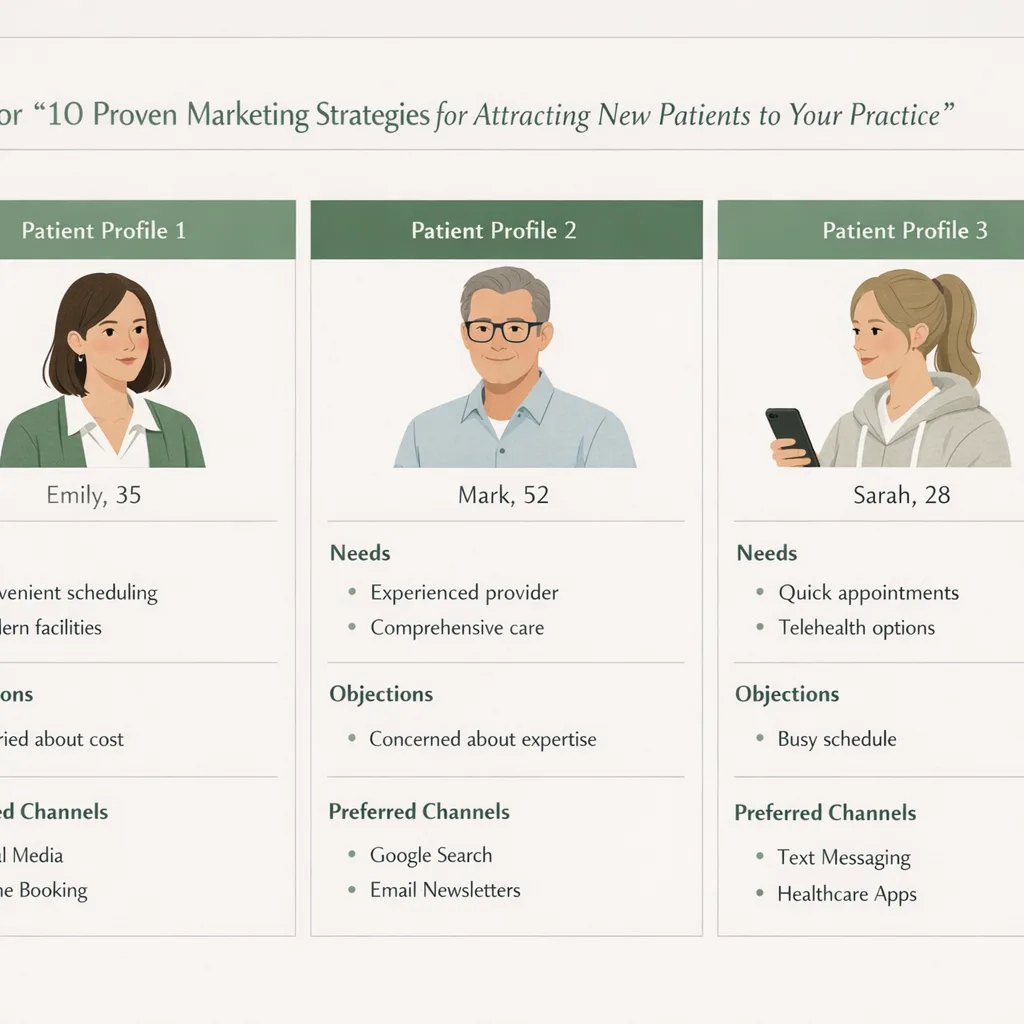
1) Define your ideal patient (and build offers around them)
Most healthcare marketing fails because it targets “everyone.” Start by identifying the patient types you’re best positioned to help—and most likely to stay.
Action steps:
- Segment by condition, payer, location, and urgency (e.g., “acute back pain within 10 miles,” “post-op rehab,” “pediatric speech eval”).
- Clarify your differentiator in one sentence (even if it’s operational): “Same-week appointments,” “evening hours,” “insurance verified before visit,” etc.
- Create 2–3 “patient-ready” offers:
- New patient evaluation + care plan discussion
- Second opinion consult
- Fast-track scheduling for urgent needs
Why it works: clear positioning improves conversion across every channel—ads, referrals, SEO, and calls—because patients instantly know they’re in the right place.
2) Win the “near me” search with local SEO fundamentals
Local search is one of the highest-intent sources for patient acquisition. Patients searching “dentist near me,” “physical therapy in [city],” or “urgent care open now” are often ready to book.
Local SEO checklist:
- Optimize your Google Business Profile (GBP): correct categories, services, photos, and Q&A.
- Ensure NAP consistency (name, address, phone) across directories.
- Add service-area pages to your site (one per city/neighborhood you serve).
- Publish FAQs that match real search language (“Do you take [insurance]?” “How soon can I be seen?”).
- Make sure your website is mobile-fast and click-to-call is prominent.
Conversion tip: local SEO traffic is only valuable if you answer quickly and book efficiently. Pair SEO with a strong intake workflow like New Patient Intake so interested callers don’t fall through the cracks.
3) Build a high-converting website (focused on booking, not browsing)
Your website is your 24/7 storefront. In healthcare marketing, the goal isn’t to impress; it’s to reduce uncertainty and friction.
High-conversion website elements:
- A clear primary CTA: “Call now,” “Request appointment,” or “Book online.”
- Trust signals above the fold: reviews, credentials, affiliations, outcomes.
- Condition/service pages that explain:
- Who it’s for
- What to expect on the first visit
- Insurance/payment info
- Next steps (book now)
- A simple, mobile-friendly intake path using Patient Intake Forms.
Operational insight: If your scheduling is tight, market “next available appointment” transparently. Patients prefer honesty over endless phone tag.
4) Make the phone your #1 conversion channel (and stop losing high-intent calls)
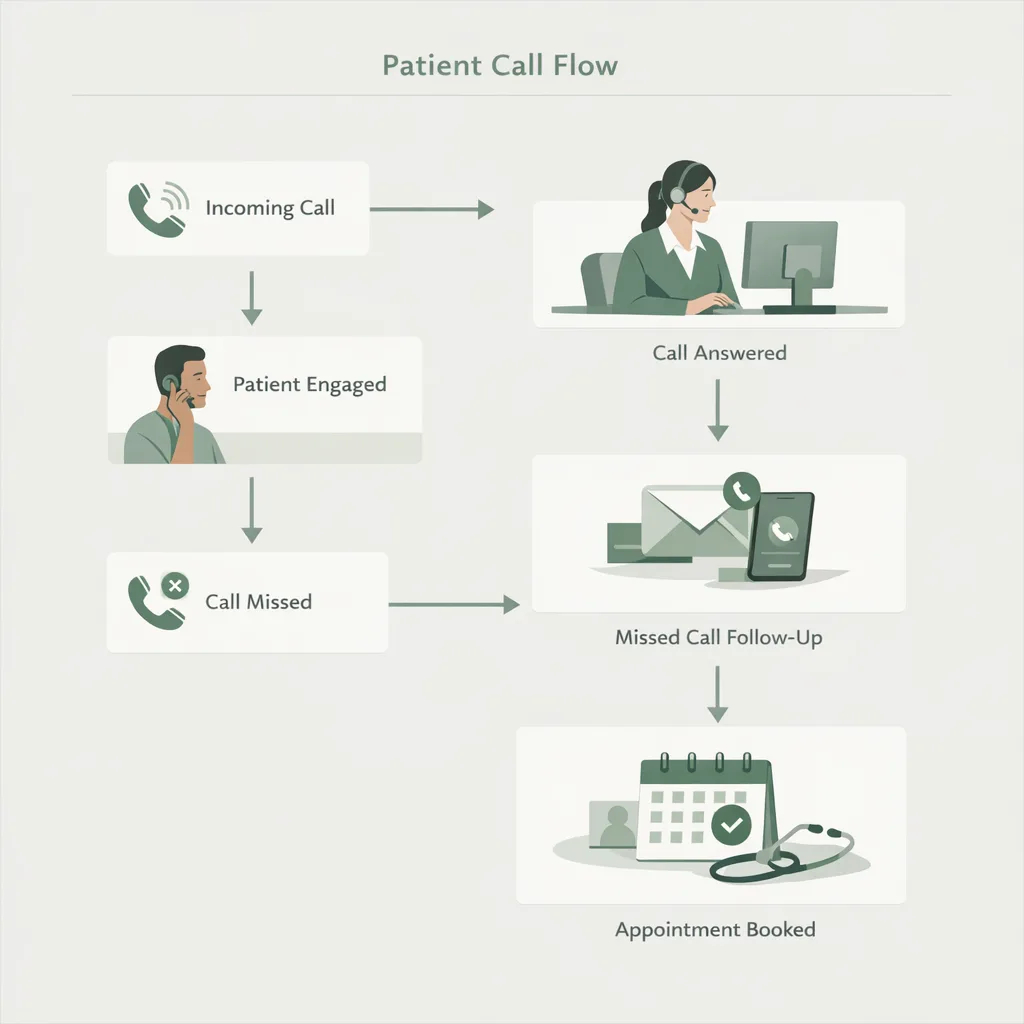
For many practices, the phone is still the highest-converting channel—especially for new patients who have questions about insurance, availability, and fit. But missed calls and long hold times quietly crush patient acquisition.
Industry benchmarks vary, but many healthcare practices miss a meaningful portion of inbound calls during peak hours—often due to understaffing, multitasking at the front desk, or after-hours gaps. Each missed call is usually a missed patient.
What to implement:
- Standardize how calls are answered, qualified, and booked.
- Use a consistent script for new patient inquiries.
- Track missed calls, callback time, and booking rate.
Resources to help:
- Read New Patient Calls That Convert for a practical framework.
- Download a ready-to-use New Patient Call Script and tailor it to your services.
If you want to reduce missed calls and improve conversion without adding headcount, FrontDesk’s AI receptionist can help capture and route inquiries and support consistent follow-up through tools like Patient Outreach and a centralized Patient CRM.
5) Launch referral engines (provider referrals + patient word-of-mouth)
Referrals remain one of the most cost-effective new patient strategies—because trust is pre-built. The key is to make referrals easy and measurable.
Provider referral playbook
- Identify 10–20 high-fit referral partners (PCPs, orthopedists, dentists, OB/GYNs, chiropractors—depending on your specialty).
- Create a one-page “referral guide” with:
- Who you treat
- Typical turnaround time
- How to refer
- What updates they’ll receive
- Set a monthly cadence: 2 visits/week + 1 educational email.
Patient referral playbook
- Ask at the right moment: after a win (pain reduction, improved function, successful procedure outcome).
- Offer a simple share option: “Send this link to a friend who needs help with X.”
- Follow up with a review request (see Strategy #6).
Pro tip: Use your Patient CRM to tag referral sources and quantify which partners and campaigns actually drive booked appointments.
6) Turn reviews into a predictable growth channel
Online reviews directly influence local search visibility and patient decision-making. A steady stream of recent, detailed reviews can outperform paid ads over time.
Review system that works:
- Ask within 24–48 hours of a positive interaction.
- Make it one click (text message is best).
- Prompt specificity: “What did we do well? Scheduling, wait time, explanation, results?”
- Respond to every review (HIPAA-safe, no PHI).
To improve the experience behind the reviews, measure it. Use a short survey like the Patient Satisfaction Survey or the printable Patient Satisfaction Survey to find friction points before they show up in public reviews.
7) Use paid search and paid social—only with strong tracking
Paid ads can accelerate patient acquisition, but only if your tracking is airtight. Otherwise, you’ll “feel busy” without knowing what’s profitable.
Best practices for healthcare marketing ads:
- Start with high-intent keywords (e.g., “same day appointment,” “sports injury clinic,” “TMJ specialist”).
- Build dedicated landing pages (not your homepage).
- Add call tracking and conversion tracking for:
- Calls
- Form submissions
- Booked appointments (the metric that matters)
- Use retargeting to re-engage site visitors who didn’t book.
Budgeting tip: Before scaling spend, know your numbers:
- Estimate capacity and growth targets with the Practice Growth Calculator.
- Understand how much you can afford to pay to acquire a patient using the Patient Lifetime Value Calculator.
8) Automate follow-up so leads don’t go cold
Many practices focus on generating leads but underinvest in follow-up. Yet a large share of “lost” new patients are simply people who called after hours, left a message, or needed time to decide.
Follow-up system essentials:
- Respond within 5–15 minutes during business hours when possible.
- Use multi-touch follow-up (call + text + email) over 3–7 days.
- Personalize by service line and urgency.
- Provide a clear next step: “Here are 2 appointment options—what works?”
FrontDesk can support this with structured workflows and messaging through Patient Outreach, while keeping every interaction organized in your Patient CRM.
9) Improve the patient experience to increase acquisition (yes, acquisition)
Patient experience isn’t just retention—it’s marketing. A smoother journey creates better reviews, more referrals, and higher conversion rates from the same lead volume.
If you want a blueprint, start with the end-to-end journey:
High-impact experience upgrades:
- Reduce pre-visit uncertainty with clear “what to expect” messages.
- Send reminders that include parking, paperwork, and timing.
- Offer simple intake that can be completed on mobile.
- Address anxiety proactively—especially for first-time patients.
For practices using AI tools, personalization can be a differentiator:
- How AI Can Personalize the Patient Experience in Healthcare
- The Role of AI in Reducing Patient Anxiety Before Appointments
10) Track the right metrics and run monthly growth experiments
Marketing isn’t one project; it’s a system of small experiments. The practices that grow consistently measure performance, identify bottlenecks, and iterate.
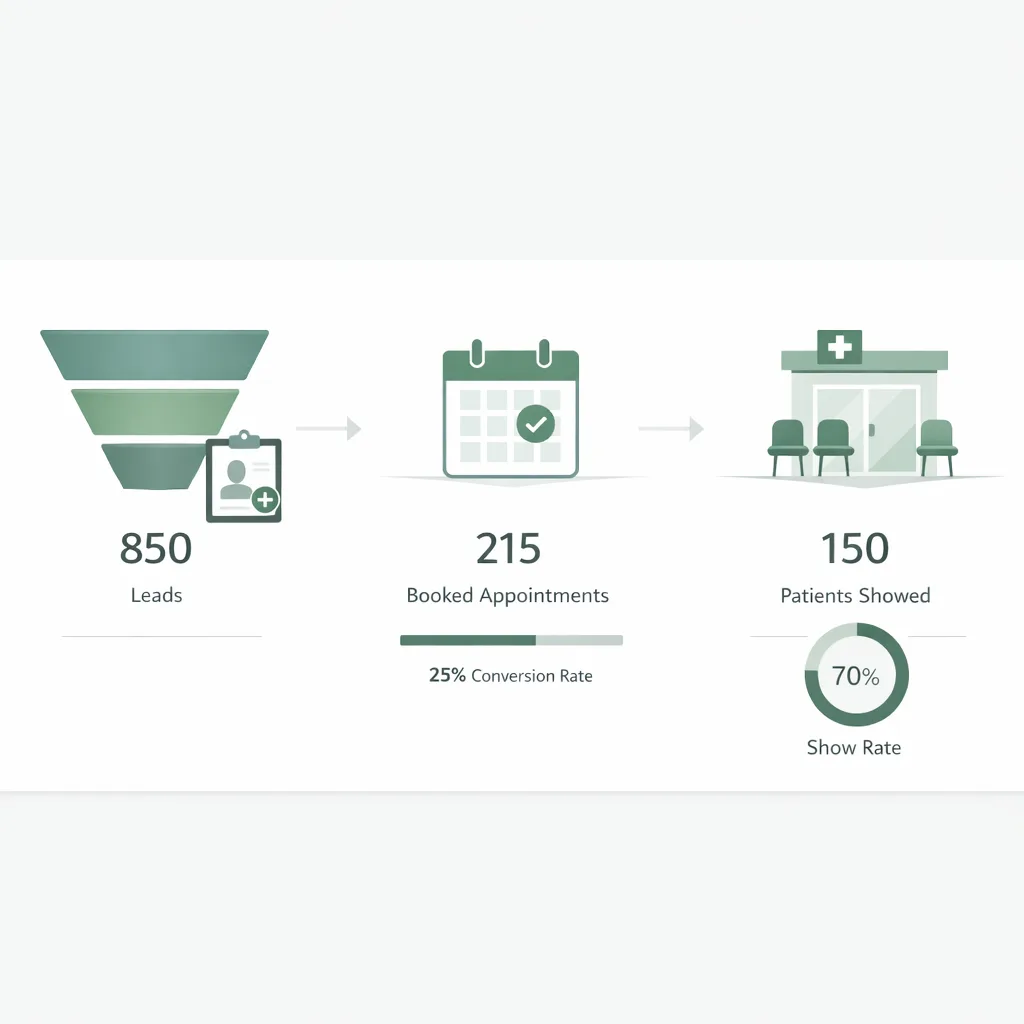
The 5 metrics to track monthly
- Lead volume by channel (calls, forms, chat, walk-ins)
- Speed to answer (and missed call rate)
- Lead-to-appointment conversion rate
- Show rate (and cancellation rate)
- Cost per booked appointment (for paid channels)
To make this easier, centralize reporting with tools like Practice Analytics so you can see what’s driving booked appointments—not just clicks.
A simple experiment cadence
Each month, pick one bottleneck and run one improvement.
- Month 1: reduce missed calls
- Month 2: improve website landing page conversion
- Month 3: launch review requests + referral outreach
Quick-start plan: choose strategies based on your biggest bottleneck
Use this table to decide what to implement first based on where you’re losing patients.
| Bottleneck | What it looks like | Best strategies to start | Tools/resources to use |
|---|---|---|---|
| Not enough leads | Low call/form volume, empty schedule | Local SEO, paid search, referral outreach | Practice Growth Calculator, Patient Outreach |
| Leads not converting | Calls but few bookings, lots of “just checking” | Call scripting, faster response, better landing pages | New Patient Calls That Convert, New Patient Call Script |
| High no-show/cancel | Full schedule but frequent gaps | Better reminders, expectation setting, intake improvements | New Patient Intake, Patient Intake Forms |
| Weak word-of-mouth | Few reviews/referrals despite good care | Review system, patient satisfaction measurement | Patient Satisfaction Survey, Patient Satisfaction Survey |
| Unsure what’s working | Marketing spend feels random | Funnel tracking, channel attribution | Practice Analytics, Patient CRM |
Frequently Asked Questions
What is the fastest way to get new patients?
The fastest path is usually a combination of high-intent channels (Google Search ads or “near me” local SEO) plus strong phone conversion. If you’re missing calls or slow to respond, fix that first—conversion improvements often produce immediate gains without increasing spend.
How much should a practice spend on healthcare marketing?
A common planning range is 3–10% of revenue, but the right number depends on capacity, margins, and patient lifetime value. Use the Patient Lifetime Value Calculator to set a target cost per acquired patient you can sustain.
How do I know which patient acquisition channel is working?
Track every lead source and measure booked appointments (not just clicks or calls). A simple dashboard that connects lead volume, conversion rate, and cost per booked appointment will show which channels deserve more budget.
What should my front desk say to convert more new patient calls?
Your team should quickly confirm the caller’s need, communicate next available times, and confidently guide them to book—while addressing insurance and “what to expect.” Start with the New Patient Call Script and refine it based on real objections you hear.
How can AI help with patient acquisition without hurting the patient experience?
AI can help you respond faster, reduce missed calls, and deliver consistent follow-up—especially after hours—while keeping messaging clear and patient-friendly. When implemented thoughtfully, it improves access and reduces anxiety, which can increase conversions and reviews.
Conclusion: build a patient acquisition system, not a one-time campaign
The most reliable healthcare marketing doesn’t rely on a single tactic. It combines visibility (SEO, referrals, ads) with conversion (phones, follow-up, intake) and measurement (funnel metrics and profitability). If you implement even 3–4 of the strategies above—and track results monthly—you’ll create a repeatable engine for attracting new patients.
If you’re ready to reduce missed calls, streamline new patient intake, and turn follow-up into a competitive advantage, FrontDesk can help you put these new patient strategies on autopilot—without adding more pressure to your front desk team.