The Role of AI in Reducing Patient Anxiety Before Appointments

Patient anxiety doesn’t start in the exam room—it starts the moment someone thinks, “I need to book an appointment.” For many patients, uncertainty about cost, pain, time, paperwork, or simply “what happens next” can trigger stress that leads to cancellations, no-shows, or delayed care. The good news: AI in healthcare is increasingly effective at reducing patient anxiety before appointments by making preparation clearer, communication faster, and experiences more predictable.
Why patient anxiety happens before an appointment
Pre-visit anxiety is often less about the clinical outcome and more about the unknowns. Healthcare practice owners and office managers see this play out every day: patients call multiple times, arrive unprepared, or avoid scheduling altogether.
Common anxiety triggers include:
- Uncertainty about logistics: location, parking, arrival time, what to bring
- Fear of judgment: symptoms, lifestyle factors, “wasting the doctor’s time”
- Financial concerns: insurance coverage, copays, surprise bills
- Past negative experiences: long waits, confusing instructions, rushed interactions
- Paperwork overload: forms, consents, medical history, referrals
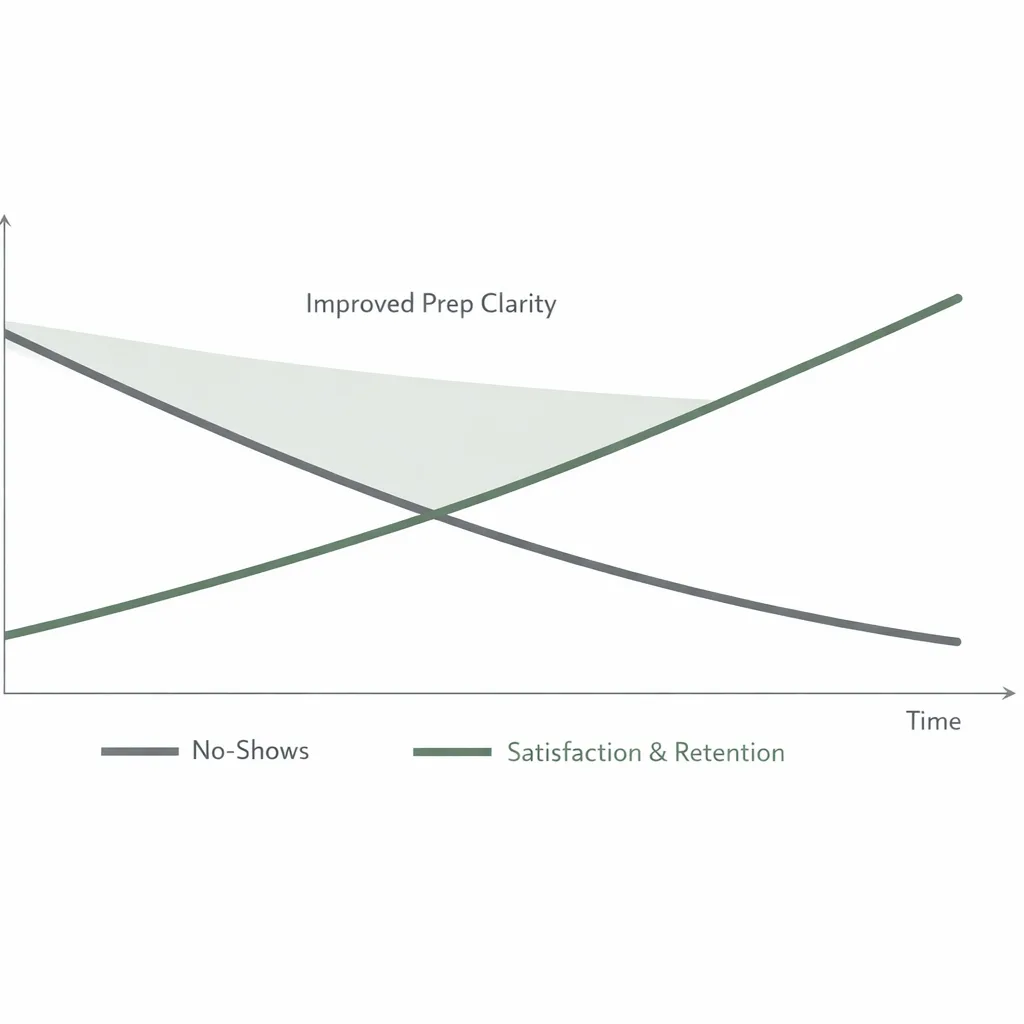
Reducing patient anxiety is not just a patient experience issue—it’s an operational one. Lower anxiety is linked to better adherence, fewer no-shows, and higher satisfaction. (Studies in patient experience consistently show that clear communication and expectation-setting are major drivers of satisfaction and perceived quality of care.)
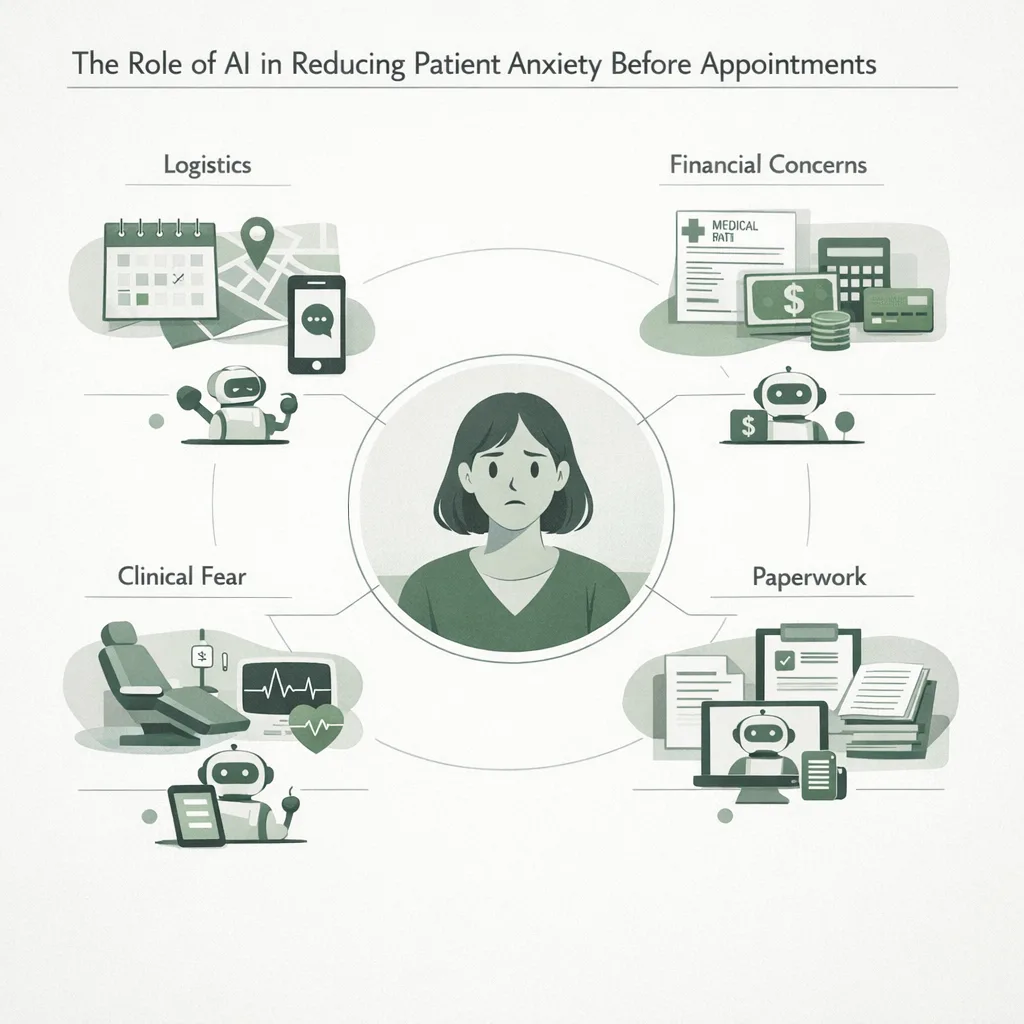
How AI reduces anxiety: predictability, responsiveness, and personalization
AI is most helpful when it removes friction from the moments patients find stressful: booking, intake, reminders, and day-of communication. In practical terms, AI reduces anxiety by:
- Answering questions immediately (without long hold times)
- Standardizing instructions so patients don’t get mixed messages
- Personalizing appointment preparation based on visit type
- Proactively checking in to identify barriers early
- Reducing administrative burden so staff can focus on high-touch care
FrontDesk supports these workflows through AI-powered patient communication and automation—especially across Appointment Scheduling and New Patient Intake.
Appointment preparation: where AI has the biggest impact
1) AI-assisted scheduling that lowers the “first-call” stress
The first contact is often the most anxiety-filled. Patients may worry about being rushed, misunderstood, or told they “need to call back.” AI reception and automation can reduce this by ensuring patients can:
- Book or request an appointment without waiting on hold
- Get clear next steps (what to bring, when to arrive, how long it takes)
- Receive immediate confirmation and written instructions
For practices, improving the first-call experience also boosts conversion. If you’re refining your intake flow, FrontDesk’s guide on New Patient Calls That Convert pairs well with AI-based routing and response.
2) Proactive outreach that addresses anxiety before it becomes a cancellation
Many cancellations happen because a patient didn’t know something important (fasting requirements, medication adjustments, transportation needs) until it was too late. AI-driven outreach can identify these issues earlier.
With FrontDesk Patient Outreach, practices can:
- Send pre-visit check-ins (“Do you have any questions before tomorrow?”)
- Offer quick replies to common concerns (parking, arrival time, forms)
- Escalate complex questions to staff when needed
Actionable tip: Add a simple “barrier check” message 48–72 hours before the visit:
- “Any concerns about arriving on time, paperwork, or cost?”
- “Do you need directions or accessibility info?”
- “Do you have questions about how to prepare?”
3) Smarter reminders that reduce uncertainty (and no-shows)
Generic reminders reduce no-shows—but anxiety drops even more when reminders include preparation details. AI can tailor reminders by appointment type (new patient vs. follow-up, procedure vs. consult).
Use proven language and sequences from FrontDesk’s Appointment Reminder Templates and the Appointment Reminder SMS template to create reminders that:
- Confirm date/time/location
- State arrival time expectations (e.g., “arrive 15 minutes early”)
- Include what to bring (ID, insurance card, referral)
- Provide a simple reschedule path (reduces ghosting)
4) Digital intake that reduces “paperwork panic”
Paperwork is a major driver of patient anxiety—especially for new patients who fear they’ll forget something or show up late. AI-supported intake flows reduce stress by sending forms early, confirming completion, and answering form-related questions.
Pair AI communication with digital forms using resources like Patient Intake Forms and FrontDesk’s New Patient Intake workflows.
For deeper operational guidance, see The Ultimate Guide to Digital Forms: Streamlining Patient Intake and Documentation.
What to automate vs. what to keep human
Not every anxious patient needs the same type of support. A thoughtful approach is to automate the repetitive, predictable tasks and reserve staff time for nuance and empathy.
Here’s a practical breakdown:
| Patient need | Best handled by AI | Best handled by staff | Why it reduces anxiety |
|---|---|---|---|
| Appointment confirmation, directions, parking info | ✅ | Instant answers remove uncertainty | |
| Reminder sequences and prep instructions | ✅ | Consistency prevents missed steps | |
| Basic insurance/fee FAQs (general info) | ✅ | Reduces financial ambiguity early | |
| Complex clinical questions or sensitive concerns | ✅ | Human reassurance and judgment matter | |
| Rescheduling/cancellation workflows | ✅ | ✅ | Automation offers speed; staff handles edge cases |
| New patient “what to expect” coaching | ✅ | ✅ | AI provides baseline; staff personalizes if needed |
Actionable tip: Create a “handoff rule” for your team—e.g., any message mentioning severe pain, fear, trauma history, or billing disputes routes to a human within a defined SLA.
Using AI to make communication feel more reassuring (not robotic)
Patients don’t just want speed—they want clarity and warmth. The best AI experiences reduce anxiety by sounding confident, consistent, and respectful.
Use a “what to expect” structure
For most visit types, patients want the same three things:
- What will happen? (steps of the visit)
- How should I prepare? (forms, meds, fasting, clothing)
- What should I do if I’m worried? (contact options)
You can standardize this in scripts and messages. For phone workflows, adapt a consistent opener from the New Patient Call Script and mirror it in SMS/email.
Personalize without overstepping
AI can personalize using appointment type, provider, and timing (e.g., “Since this is your first visit…”). Avoid personalization that could feel invasive. In healthcare, reassurance often comes from simple, accurate information rather than overly familiar language.
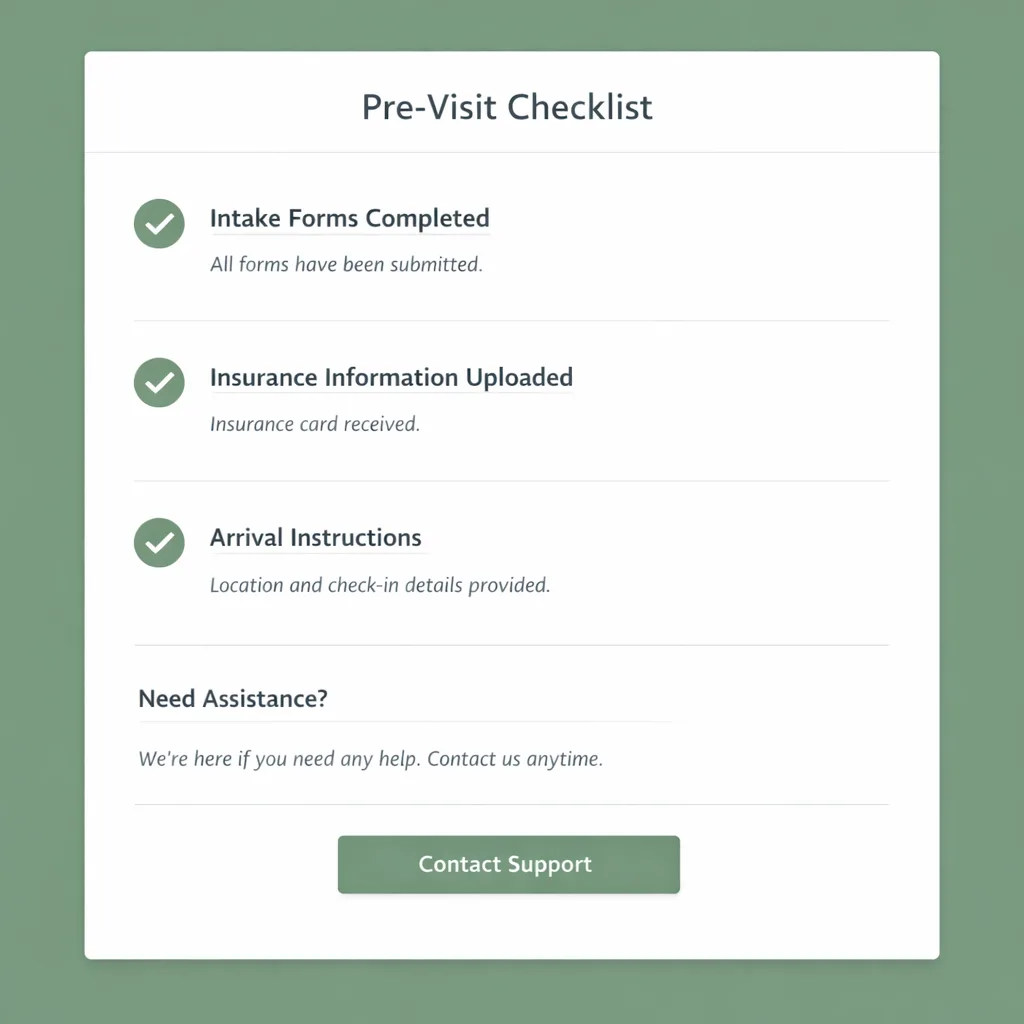
Reduce cognitive load with checklists
Instead of paragraphs, use bullet points:
- Bring: photo ID + insurance card
- Arrive: 15 minutes early
- Complete: intake forms (link)
- Questions? Reply to this message
Measuring whether anxiety is actually going down
To manage patient anxiety, you need feedback loops. Many practices measure no-shows and cancellations but don’t measure pre-visit confidence.
Add lightweight measurement:
- A one-question pre-visit check-in: “Do you feel prepared for your appointment?” (Yes/Somewhat/No)
- A post-visit question: “Were instructions clear before your visit?”
Use FrontDesk’s Patient Satisfaction Survey or the Patient Satisfaction Survey template to capture trends.
Operational metrics to track:
- No-show rate by appointment type
- Reschedule rate within 24 hours of appointment
- Call volume spikes (often signal unclear instructions)
- Form completion rate before arrival
- Patient satisfaction related to communication
Why reduced anxiety improves retention (and revenue)
Lower anxiety improves follow-through—patients are more likely to show up, complete treatment plans, and return. That makes anxiety reduction a retention strategy, not just a “nice to have.”
For retention ideas, review Maximizing Patient Retention: Proven Strategies for Healthcare Practices and FrontDesk’s guide on Physical Therapy Patient Retention (useful even beyond PT).
If you want to quantify the business impact of better experiences, the Patient Lifetime Value Calculator can help estimate how improved retention compounds over time.
A practical 7-day implementation plan for office managers
If you’re starting from scratch, this is a realistic way to improve appointment preparation without overwhelming your team.
- Day 1: Audit your top 10 patient questions
- Pull from call logs, voicemail, front desk notes
- Day 2: Standardize “what to expect” instructions by visit type
- New patient, follow-up, procedure, evaluation
- Day 3: Update reminder messages
- Use Appointment Reminder Templates and include prep bullets
- Day 4: Add digital intake links and completion tracking
- Day 5: Set escalation rules for anxious/sensitive messages
- Define when staff must intervene
- Day 6: Launch a one-question preparedness check-in
- Track “Not prepared” responses and reasons
- Day 7: Review metrics and refine
- Look at replies, cancellations, no-shows, staff workload
Frequently Asked Questions
Can AI really reduce patient anxiety, or does it feel impersonal?
AI reduces anxiety when it improves clarity and responsiveness—especially for routine questions and reminders. The key is using warm, plain language and giving patients an easy way to reach a human when needed.
What’s the biggest pre-appointment anxiety trigger practices can fix quickly?
Unclear instructions. When patients don’t know where to go, what to bring, or how to prepare, stress rises fast. Updating reminders and sending a simple pre-visit checklist is often the fastest win.
How do we use AI in healthcare without risking privacy issues?
Use platforms designed for healthcare workflows and ensure your processes follow applicable privacy and security requirements. Limit sensitive details in SMS, and route clinical or complex topics to secure channels or staff when appropriate.
Will AI increase patient messages and overwhelm staff?
It can increase message volume at first because patients finally have an easy way to ask questions. But with good automation and escalation rules, most routine inquiries are resolved without staff involvement—reducing phone calls and last-minute chaos.
How should we measure whether appointment preparation is improving?
Track no-shows, late arrivals, form completion rates, and patient feedback on communication clarity. A short satisfaction survey and a one-question “Do you feel prepared?” check-in provide quick, actionable signals.
Conclusion: reduce anxiety by making the next step obvious
Reducing patient anxiety is fundamentally about replacing uncertainty with clear, timely guidance. AI enables that at scale—through faster answers, consistent appointment preparation, and proactive outreach that catches problems before they become cancellations.
If you want to modernize your pre-visit experience without adding workload, FrontDesk can help you automate scheduling, reminders, intake, and patient communication—so patients feel prepared and your team stays focused on care. Explore FrontDesk tools like Patient CRM and Appointment Scheduling to start building a calmer, more reliable front door to your practice.